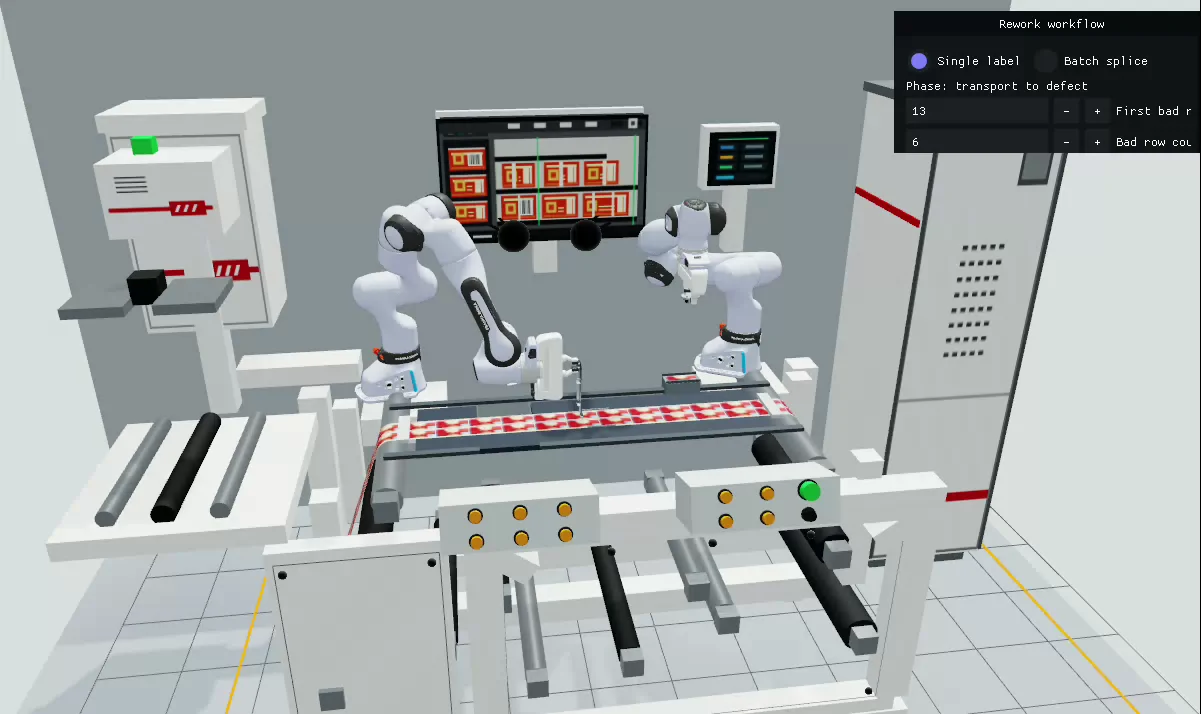
Define the task before choosing simulation fidelity
Start a physics-simulation assessment with the task. Is the robot navigating a passage or inserting a roll into a machine? The first emphasizes passage, localization and obstacles; the second also needs contact, friction, gripping and alignment. Visual resemblance does not replace these conditions. Model detail should follow the questions being tested.
The material models scenes, robots, sensors and task workflows separately. This helps locate failures: occlusion, inaccurate parameters, unreachable motion or missing task rules can be investigated individually, instead of attributing every problem to model capability.
Hazardous conditions must be repeatable and results comparable
Simulation lets teams repeatedly construct edge conditions that are unsuitable for frequent trials on a real site: occlusion, extreme lighting, passing people or changing equipment states. Replayable conditions allow comparison before and after a policy update. Successful videos alone rarely show what actually improved.
Alongside images and actions, link records to tasks, robot configurations, environmental conditions and success/failure labels. Keep failure segments and reasons for human takeover too. Otherwise training may capture only the normal workflow, leaving exception recovery to improvisation on site.
Pilot trials expose errors that simulation did not explain
The material proposes a simulation–pilot–production feedback path. After pilots, check how errors and data feed back: does localization drift need recalibration, contact behavior require physical-parameter adjustment, or task failure reveal a missing condition? The loop is complete only when field data changes the next simulation.
Assess task completion, action safety, exception recovery and continuous operation separately. Passing simulation supports entry to the next phase; stable operation still needs validation with the actual configuration and a frozen task definition. This is the necessary step from demonstrations to reproducible engineering results.